.png?width=684&height=209&name=YouLead%202024%20-%20Digital%20Growth%20Agency%20branco-laranja%20(1).png "YouLead 2024 - Digital Growth Agency branco-laranja (1)")

July 19, 2021
Keywords are the foundation of SEO. Keywords are the terms people use to search on search engines like Google.
The goal of any company is for people to find its website among the top results on Google when they search for terms related to its business—such as its products or services.
However, to achieve this, companies need to have a clear understanding of whichkeywords potential customers are using when they perform a search for a need that can be met by one of their solutions. It is in this context that keyword research proves to be extremely important.
What are keyword studies?
Keyword research is a process that involves identifying and understanding the search terms people use on search engines when they are looking for a product, service, content, or solution to address a specific need or concern.
This analysis provides companies with important data on the words and phrases that potential customers may be using in their searches—data that is essential for an SEO and digital marketing strategy from a broader perspective.
Conducting a keyword study is the only way to find out what people are searching for and, thus, to avoid creating irrelevant content that no one is looking for.
But then, what steps should you follow to conduct a keyword study that supports your SEO strategy?
1 - Make a list of relevant topics related to your business
Typically, the first set of topics or phrases that come to mind will be the most strategic, as they’ll be closely related to your products, services, or solutions. These topics will be the most important ones—and the ones for which you want your website to rank (appear on Google’s search results pages).
Also, put yourself in the shoes of your buyer personas and try to identify the topics they are most likely to search for (and, of course, the ones for which you’d like your website to be found).
For example, in the case of YouLead, some important topics are: inbound marketing, digital transformation, digital marketing, marketing automation, HubSpot, etc…
2 - Find the keywords associated with these topics
Although the topic “digital marketing” is relevant to YouLead, it may not necessarily be a strategickeyword, since it is too generic and those searching for it may have diverse and ambiguous intentions (which do not align with our website’s content or the solutions we offer).
Therefore, it’s important to find long-tail keywords that fit within the topics defined in the previous step and that are most likely the phrases used in searches conducted by your target audience.
For the example of the topic “digital marketing,” some keywords might be: digital marketing agencies, digital marketing strategies, digital marketing tools, etc…
The idea is to start with just an initial list of strategic keywords related to a topic. It’s only natural that this list will undergo changes in the following steps.
3 - Always takesearch intent into account
As we saw earlier, the intent behind why people perform a particular search is a crucial aspect to consider in your keyword research. A keyword can have several meanings, and while one of them may be related to your business, others may not be.
Let’s look at an example that’s simpler than the one about marketing automation. Imagine your company specializes in human resources consulting: the keyword “human resources” might seem relevant and the most obvious choice in your keyword research. However, many searches related to human resources may actually be looking for “degrees in human resources” or “human resources job openings” rather than “human resources consulting” or “human resources management firms,” for example.
Thus, it’s easy to see the importance of considering search intent. In practical terms, your pages and content should aim to address the problem or need that the person’s search revealed.
4 - Look for related terms
It’s only natural that, even with your experience, you won’t remember all the possible keywords that people might use to search for information on a particular topic.
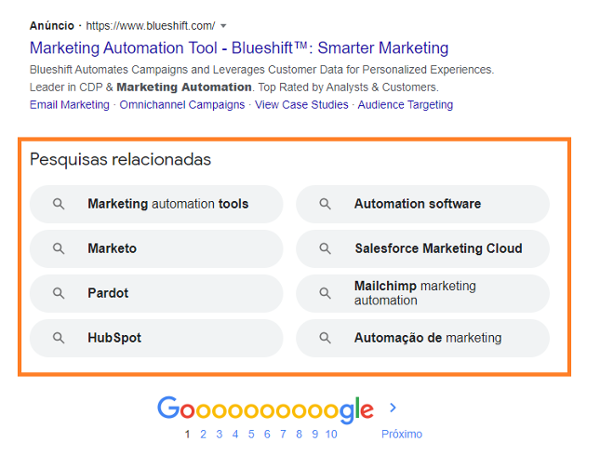
A helpful resource is the “related searches” section that Google usually displays at the bottom of the results page when you perform a search. These related keywords can spark ideas for potentially relevant keywords to consider.
5 - Use keyword research platforms
There are several SEO tools that can help you come up with more strategic keyword ideas for your business. What’s more, they can provide you with important information such as keyword popularity (monthly search volumes), your website’s current ranking for those keywords, ranking difficulty, and the organic CTR for those keywords.
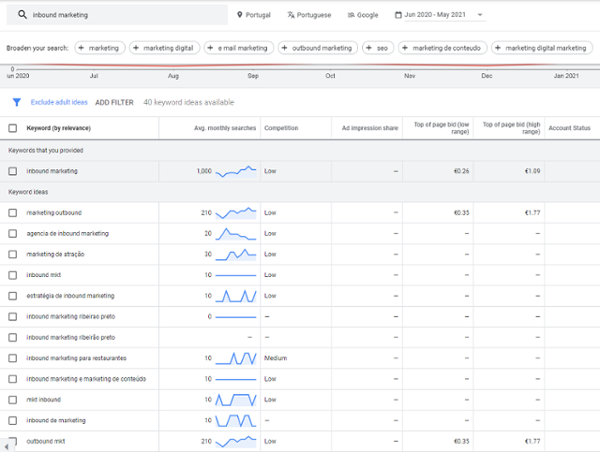
Some of these tools include MozPro, SEMrush, and Ahrefs, for example. But Google also offers a keyword research tool, which is perhaps the best known and can be used for free: the Google Keyword Planner.
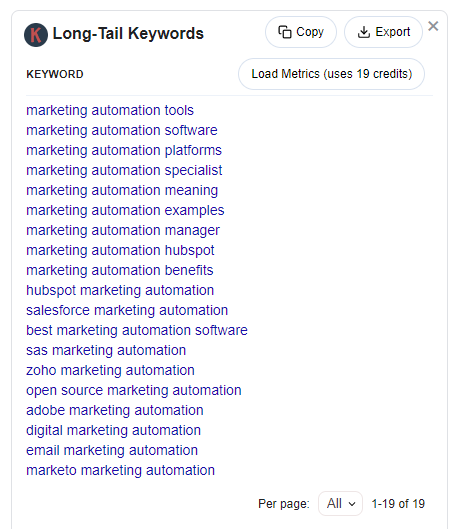
In addition, you can install a Google Chrome extension called Keywords Everywhere, which also displays a list of keywords related to your search query.
With the help of these platforms and the data they provide, you’ll be able to identify the most strategic keywords for your business—the ones you should optimize as part of your SEO strategy.
These keywords should strike a balance between relevance, authority, and search volume. In other words, they should be keywords with reasonable search volumes for which your website can compete, taking into account both existing competition and your ability to produce valuable, high-quality content that addresses those specific search terms.
That said, and once you’ve gone through all these steps, you’re now ready to start optimizing your website (and other digital channels) and your content for the keywords identified as the most strategic.
And don’t forget: SEO efforts never yield immediate results. So start your keyword research now to build your business’s authority on search engines in the medium to long term.
Would you like YouLead’s help in developing a keyword study? Don’t hesitate to contact us.

Content originally published in July 2021.