January 22, 2021
Google updates its algorithm hundreds of times a year. And although most of these changes are minor, some of them are significant and should be taken into account in a solid SEO strategy.
As we’ve already seen in this article on marketing trends for 2021, some of these changes are closely tied to how people search for information and to updates in search engines.
For this reason, we’ll now focus on SEO trends—that is, the strategies and tactics that will be crucial for dominating organic traffic in 2021.
1 - Focus on the user and search intent
This isn’t necessarily a new trend, but rather something that must be considered year after year. This is because consumer behavior and search intent are constantly changing—especially after 2020, a year in which they changed dramatically.
The ultimate goal of any search engine is to deliver the most relevant content that matches users’ searches. And in this regard, Google has been developing its algorithm to better understand the search terms used (to discern the intent behind those searches).
In this context, it’s important to create content and optimize your website so that it addresses a specific search intent. This requires a solid understanding of the queries being used (questions asked, long-tail keywords, and phrases, etc.).
2 - Voice Search
Technological innovations such as Siri, Alexa, and even Google Assistant have driven the growth of voice search in recent years. Voice search is based on the principle of convenience, as it is much easier to speak into a smartphone than to type what we want to search for.
So, if you aren’t already doing so, it’s essential that you start optimizing your content for voice search. And what does that mean? It means taking into account phrases and words that people might use in their voice searches but probably wouldn’t use in a text-based search (when we type, we tend to abbreviate).
For example, if we’re looking for information on SEO trends for 2021, when we type into the Google search bar, we’ll most likely enter something like “SEO trends 2021.” In contrast, if we search using voice, we’re likely to say “what are the top SEO trends for 2021.”
In practical terms, this may require optimizing your content by using compound phrases with words like “what,” “how,” “when,” etc.
And, by the way, since voice searches are typically conducted on smartphones (though not solely for this reason), it’s critical that your website be optimized for mobile devices.
3 - Zero-click searches
In recent years, Google has made changes to the layout of the results page itself in order to deliver a better (and more effective) user experience. One of these changes concerns zero-click searches.
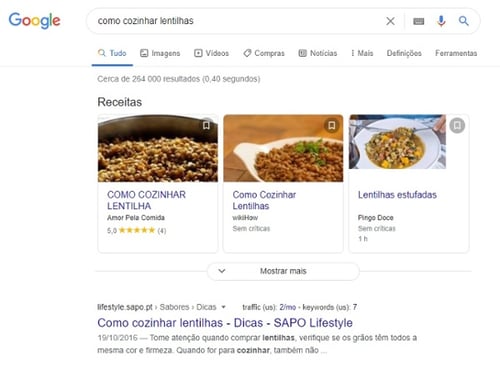
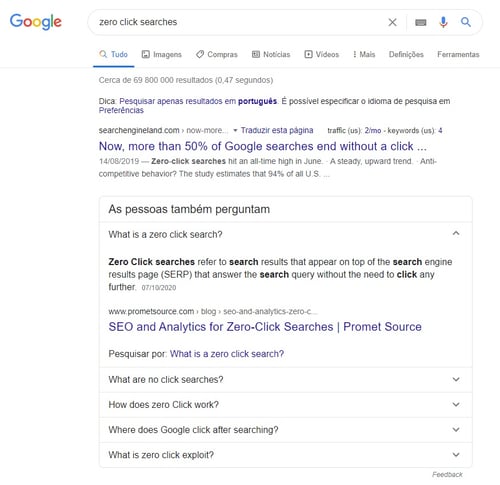
Zero-click search results are those that appear right at the top of the Google results page and provide such a direct answer to the user’s query that the user doesn’t even need to click on the result and visit the corresponding page (the content opens directly in Google).
Google identifies a specific excerpt from a page or website that it considers most relevant to the search query and displays it directly on the results page.
With this in mind, you should optimize your content to provide clear, definitive answers to specific, predictable questions from your buyer persona. That way, when someone performs that search, your website can appear in Google’s zero-click results.
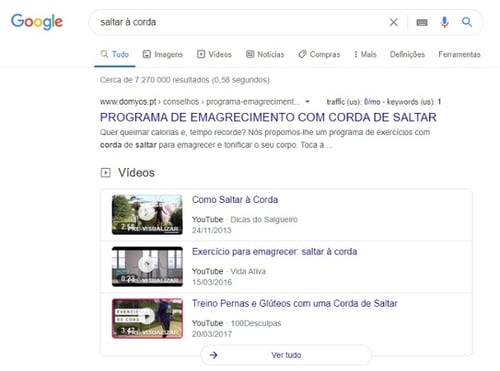
4 - Including Video
Video is a tool that no marketing professional can ignore. The number of users on YouTube (over 1 billion) and other video-sharing platforms proves just that: video has become one of the most relevant content formats, if not the most relevant.
But rather than simply creating videos and sharing them across your various digital channels (social media, website, blog, etc.), you need to optimize them for search engines. Note that video titles and channel descriptions should provide users with an overview of your content.
In addition, keywords are very important. Make sure your videos align with what people are searching for (on Google or YouTube) and incorporate those same keywords so they can be found.
5 - E-A-T Principle
It’s no secret that Google works to display results with higher-quality content, rather than those it doesn’t consider as relevant.
It’s true that the concept of “quality” has evolved over time: whereas it used to be based more on the number of backlinks a site had or the quality of external sites linking to it, today Google makes it clear what determines a website’s quality.
This quality is based on the E-A-T principle: expertise, authoritativeness , and trustworthiness . These three criteria help determine whether or not a page has useful and valuable content.
So, how can you optimize your content to align with this principle? There are a few elements you should aim to follow in this process:
- Understand who your buyer personas are so you can produce content that meets their needs or helps address their concerns and “pain points”;
- Map out yourbuyer’s journey so that your content is tailored to each specific stage of the purchasing decision process;
- Produce useful content in the format most relevant to your persona (blog posts, eBooks, videos, infographics, case studies, etc.) and distribute it across multiple channels (the channels where your persona is active).
When it comes to SEO (or, in fact, any digital marketing strategy), it’s critical to stay on top of all trends and innovations, as they are constantly evolving.
Adapting to these trends is absolutely essential for improving your website’s ranking on Google and your organic traffic strategy from a broader perspective. At the same time, there are best practices that should remain unchanged —such as link building, on-page SEO, and, ultimately, the creation of useful, relevant, and original content.
Want to make your SEO strategy stronger in 2021? At YouLead, we can help you.

Content originally published in January 2021.